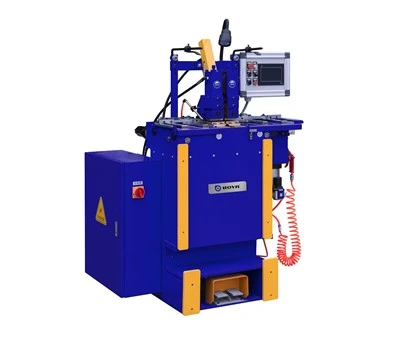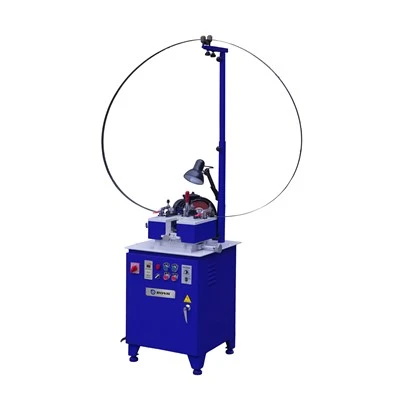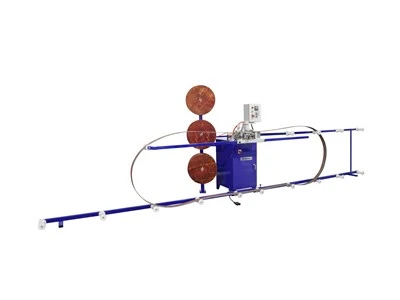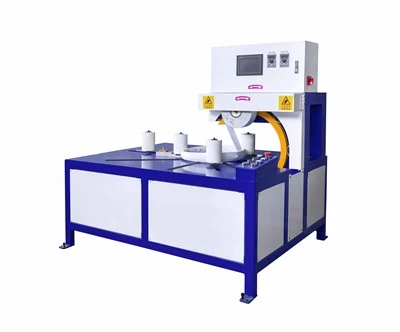

Many people are concerned about the band saw blade most of the problems are mainly concentrated in the band saw blade sawing theory, saw tooth shape, and manufacturing process in three areas, the manufacturing process includes the welding process, milling process, tooth tip treatment process, and sandblasting process. Today, the sandblasting process as an example, to explain the sandblasting process on the band saw blade what is the impact?
The so-called sandblasting is a metal surface treatment technology, the basic principle is to use compressed air to make the sand particles high-speed impact on the metal surface so that a very small thickness range of the metal surface layer produces intense compression deformation. A large number of studies have shown that sandblasting can effectively improve the fatigue resistance of band saw blades.
The following are the effects of two different blasting processes on the sawing performance and fatigue life of bimetallic band saw blades:
Experimental Procedures:
The band saw blades were subjected to fast high-pressure sandblasting (HSHPSP) and slow low-pressure sandblasting (LSLPSP). The two blasting processes are shown in the figure below. HSHPSP and LSLPSP processes use three guns, one gun is placed at the upper end of the saw teeth to treat the teeth and tooth grooves, and the other two guns are placed on both sides of the band saw blade to treat the blade body.
Test Methods:
Sawing tests were carried out on two kinds of band saw blades treated with a sandblasting process, and the material to be sawed was GCr15 bar material with a diameter of 80mm, which was tempered and hardened to 40-45HRC. The bar was tempered to a hardness of 40-45 HRC, and the sawing test was carried out on an Amada HA250 scissor-type band sawing machine, with a saw blade length of 3505 mm. The test was carried out at a set line speed of 40 m/min, and a feed speed and feed pressure of 2.0 (sawing gear). When one of the following three conditions occurs, the test is judged to be terminated: ① sawing deflection exceeds 2mm; ② single blade sawing time exceeds 5min; ③ band breakage. To improve the reliability of the test, each sample tested three band saw blades, recording the single blade sawing time and each band saw blade sawing number and area.
Test results:
The three sets of tests were in good agreement, and all resulted in higher sawing life for the LSLPSP-treated band saw blades. In the three sets of comparative sawing tests, the sawing life of LSLPSP band saw blades was 173%, 32%, and 67% higher than that of HSHPSP band saw blades, respectively. Two of the HSHPSP band saw blades failed due to skewing and one failed due to long sawing time (low sawing efficiency); one of the LSLPSP band saw blades failed due to skewing and two failed due to low sawing efficiency. In the three sets of sawing tests, the LSLPSP band saw blades averaged 176 cuts (8,825 cm²), which was 85% higher than the 95 cuts (4,789 cm²) of the HSHPSP band saw blades.
Fatigue testing:
Idling fatigue tests were performed on band saw blades treated by both processes and the results are shown in Figure 4. In the test results, each sample is the average of five test results. After HSHPSP treatment, the average idling time of the band saw blade is 10.4h, corresponding to 53409 cycles; while after LSLPSP treatment, the average idling time of the band saw blade reaches 16.8h, corresponding to 86,173 cycles, which is 62% higher than the life of HSHPSP band saw blade.
Summary:
The slow, low-pressure blasting process improves the sawing performance of bimetallic band saw blades, as well as the fatigue life of their blade bodies, compared to the fast, high-pressure blasting process.
The slow-speed, low-pressure blasting process removes tooth tip burrs and blunts saw tooth tips, thus reducing chipping during sawing and improving sawing performance.
(3) The slow-speed, low-pressure blasting process creates a greater residual compressive stress on the surface of the saw blade body, and at the same time makes its surface morphology more uniform, thus increasing its fatigue life.